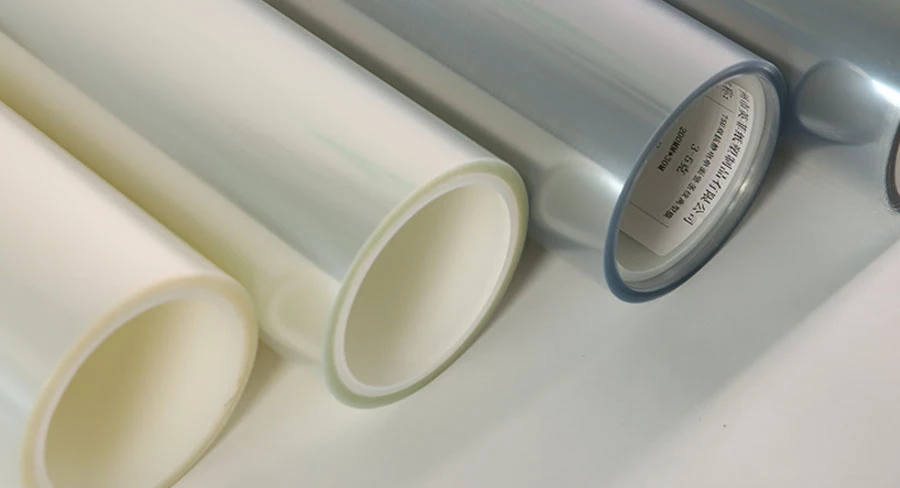
A release liner can look simple, but small changes in coating, adhesive, temperature, pressure, tension, storage, or film structure can create major production problems.
The fastest way to solve a release liner problem is to start from the symptom, identify whether the failure is at the release interface or in the liner structure, and then separate material-related causes from process-related causes.
Common complaints include:
- “The liner is too difficult to peel.”
- “The liner comes off before we want it to.”
- “Release force changes from roll to roll.”
- “The film wrinkles during lamination.”
- “The liner curls after slitting.”
- “Adhesive stays on the release film.”
- “The adhesive surface looks contaminated after peeling.”
- “The product works initially but fails after storage.”
These symptoms may involve the liner, but replacing the liner immediately is not always the correct solution. Adhesive formulation, lamination pressure, winding tension, storage temperature, die-cutting settings, and aging can produce very similar defects.
For manufacturers using release materials in tapes, labels, protective films, medical adhesives, electronics components, or other pressure-sensitive products, a systematic troubleshooting approach is more effective than trial-and-error material changes.
This guide explains the most common release liner problems and shows how to identify, correct, and prevent them when working with release film and paper-based release liners.
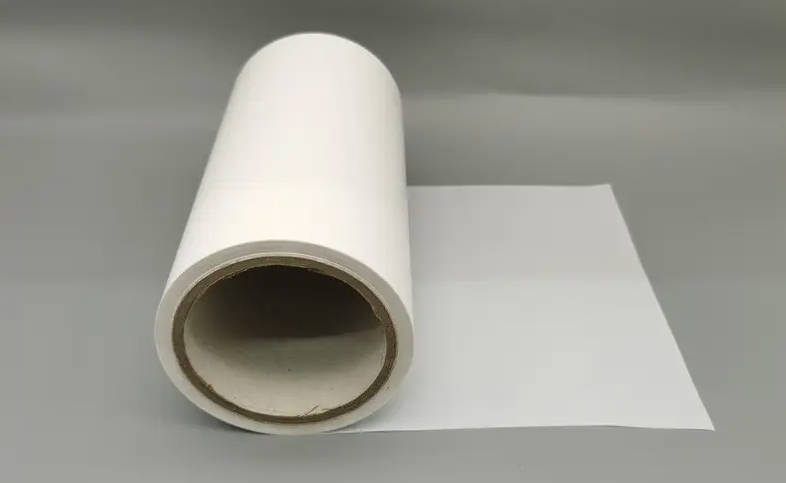
Start Here: Match the Symptom to the Likely Cause
Before changing material specifications, determine exactly what is happening.
| Symptom | Likely Cause Areas | First Check |
|---|---|---|
| Liner sticks too strongly | Release coating, adhesive tack, aging, pressure | Compare initial and aged release |
| Liner releases too easily | Release grade, adhesive tack, lamination | Check premature lifting |
| Release force is inconsistent | Coating uniformity, aging, temperature | Test different roll positions |
| Film wrinkles | Web tension, thickness, heat, winding | Check machine tension and flatness |
| Liner curls | Thermal imbalance, coating structure, humidity | Compare before and after processing |
| Adhesive residue remains | Excessive release force, weak adhesive cohesion | Inspect both adhesive and liner |
| Silicone contamination suspected | Coating cure, anchorage, migration | Check downstream bonding or wetting |
| Roll blocks during storage | Pressure, temperature, release mismatch | Review winding and storage conditions |
| Die-cut parts move or lift | Release force too low, liner instability | Test release level and liner thickness |
A visible problem on the release liner does not automatically mean the liner itself is defective.
The first objective is to determine whether the failure originates from:
- release coating,
- adhesive,
- liner substrate,
- converting process, or
- storage and aging.
Problem 1: The Release Liner Sticks Too Much
One of the most common release liner problems is excessive peeling resistance.
Operators may describe this as:
- high release force,
- difficult peeling,
- tight liner,
- adhesive pulling,
- tape stretching,
- label deformation,
- or liner sticking to the product.
Why Does Release Force Become Too High?
Possible causes include:
- Release coating does not match the adhesive.
- Release level was specified too tight.
- Adhesive becomes more aggressive after aging.
- Excessive roll pressure increases adhesive wet-out.
- Processing heat softens the adhesive.
- Silicone coating is incomplete or uneven.
- Adhesive coating weight is higher than expected.
- Storage time is longer than the original validation period.
The key question is whether the problem exists immediately or develops later.
If the Problem Appears Immediately
Focus first on:
- release coating compatibility,
- adhesive chemistry,
- coating uniformity,
- release specification,
- and adhesive coating weight.
If the Problem Appears After Storage
Focus more on:
- temperature,
- roll pressure,
- storage time,
- adhesive aging,
- and release-force stability.
| Timing of Failure | More Likely Area |
|---|---|
| Immediately after lamination | Coating or adhesive mismatch |
| After rewinding | Roll pressure or winding tension |
| After several days | Adhesive wet-out or aging |
| After heat exposure | Thermal interaction |
| Only in some roll areas | Coating uniformity or local contamination |
How to Solve It
Do not automatically move to the lowest possible release force.
Instead:
- Compare initial and aged peel behavior.
- Test a slightly easier release grade.
- Review adhesive chemistry and coating weight.
- Reduce unnecessary winding pressure.
- Check whether heat exposure is increasing adhesive tack.
- Compare samples from different positions across the roll.
The correct release force is not the easiest possible release—it is the level that keeps the product stable during converting and storage but still peels cleanly when needed.
Problem 2: The Release Liner Releases Too Easily
The opposite problem can be equally damaging.
When release force is too low, users may see:
- labels lifting during die-cutting,
- tape separating during unwinding,
- protective-film liners opening during transport,
- die-cut parts moving,
- unstable matrix stripping,
- exposed adhesive,
- or incorrect transfer in double-sided products.
Common Causes
Release may be too easy because:
- the selected release grade is too light,
- adhesive tack is lower than expected,
- lamination pressure is insufficient,
- adhesive coating weight is low,
- liner and adhesive contact is incomplete,
- or the product requires differential release rather than the same release level on both sides.
For double-sided tapes and transfer adhesives, release balance is especially important.
One surface may need to remain attached while the other releases first. If both surfaces release too easily, the adhesive can transfer to the wrong side or shift during processing.
How to Correct Easy Release
Check the system in this order:
- Verify adhesive tack.
- Confirm lamination pressure.
- Inspect the adhesive coating for uniformity.
- Test a tighter release level.
- Review winding pressure.
- Confirm whether differential release is required.
Do not assume every premature-separation issue requires a tighter liner. Weak or improperly cured adhesive can create the same symptom.
Problem 3: Release Force Changes From Roll to Roll
For production teams, unstable release force is often more difficult than consistently high or low release.
One roll runs normally. The next requires different machine settings. A third roll may release normally at the beginning but become tighter deeper into the roll.
This creates problems for:
- automated label dispensing,
- die-cutting,
- matrix stripping,
- transfer tape,
- protective film,
- and high-speed adhesive converting.
What Causes Unstable Release Force?
Possible causes include:
- uneven release coating,
- silicone curing variation,
- cross-web coating differences,
- different adhesive aging periods,
- roll pressure differences,
- inconsistent storage conditions,
- temperature variation,
- contamination,
- or batch-to-batch material changes.
A single peel test from the outer layer of one roll is often insufficient.
Better Sampling Strategy
Take samples from:
- left, center, and right across the web,
- outer and inner roll positions,
- multiple rolls from the same batch,
- material before aging,
- and material after representative storage.
| Sampling Position | What It Helps Detect |
|---|---|
| Left / center / right | Cross-web coating variation |
| Outer vs inner roll | Roll-pressure effects |
| Fresh vs aged sample | Release-force aging |
| Different rolls | Batch consistency |
| Before vs after heating | Thermal stability |
If the variation follows position on the roll, process conditions may be involved. If it follows production batch, material consistency should be investigated.
Problem 4: Release Film Wrinkles During Processing
Wrinkling is usually not a release-force problem. It is primarily a web-handling and dimensional-stability problem.
Wrinkles can appear during:
- coating,
- drying,
- lamination,
- rewinding,
- slitting,
- hot processing,
- or long-roll storage.
Typical Causes of Release Film Wrinkles
Common causes include:
- uneven web tension,
- poor roll flatness,
- liner too thin for the process,
- uneven nip pressure,
- heat-induced deformation,
- misaligned rollers,
- damaged roll edges,
- loose winding,
- excessive winding tension,
- or incompatible material stiffness.
PET release film is often selected for applications requiring good dimensional stability, but even PET film can wrinkle if tension, heat, or winding conditions are unsuitable.
Diagnose the Wrinkle Pattern
The wrinkle direction gives useful information.
| Wrinkle Pattern | Possible Cause |
|---|---|
| Wrinkles from one edge | Web alignment or edge damage |
| Wrinkles across full width | Tension or nip-pressure issue |
| Wrinkles after oven | Thermal deformation |
| Wrinkles near roll core | Winding or core issue |
| Random local wrinkles | Surface damage or contamination |
| Wrinkles increase with speed | Tension-control problem |
How to Reduce Wrinkling
Review:
- film thickness,
- web tension,
- roller alignment,
- nip pressure,
- processing temperature,
- roll winding quality,
- and core straightness.
If the process consistently requires more support than the current material provides, a thicker or more dimensionally stable release film structure may be worth evaluating.
Problem 5: Release Liner Curling
Curling is different from wrinkling.
Wrinkles are usually local deformations caused during web processing. Curling occurs when the liner naturally bends or rolls toward one side after processing, cutting, or environmental exposure.
What Causes Curling?
Possible factors include:
- unequal stress between two surfaces,
- one-side coating,
- thermal shrinkage,
- humidity changes,
- tension during coating,
- uneven cooling,
- paper moisture absorption,
- or long-term rolled storage.
Paper-based release liners are generally more sensitive to humidity changes than film-based liners.
Film liners can also curl if one surface experiences different heat, tension, coating, or shrinkage conditions.
When Curling Becomes a Serious Problem
Curling can interfere with:
- sheet feeding,
- label dispensing,
- die-cut component handling,
- automatic assembly,
- lamination,
- and manual application.
For small die-cut components, even moderate curl can cause parts to lift from the carrier.
Possible Corrective Actions
- Allow material to condition before converting.
- Review storage humidity and temperature.
- Reduce thermal imbalance.
- Adjust web tension.
- Review coating structure.
- Check whether the liner is too thin.
- Evaluate a more stable substrate.
Problem 6: Adhesive Residue Stays on the Release Liner
Adhesive residue is often blamed directly on release film, but the real failure may be inside the adhesive.
When peeling occurs correctly, the adhesive should remain on the intended product structure.
If adhesive remains on the liner, there are two main possibilities:
- the adhesive bonds too strongly to the release surface, or
- the adhesive itself splits internally.
How to Tell the Difference
| Observation | More Likely Cause |
|---|---|
| Thin adhesive layer left evenly on liner | Release interface too strong |
| Adhesive looks stretched or stringy | Low adhesive cohesive strength |
| Residue appears after heat | Adhesive softening or wet-out |
| Residue appears only after storage | Aging and roll pressure |
| Residue appears only in certain lanes | Coating uniformity |
| Residue occurs with one adhesive only | Adhesive compatibility |
Corrective Actions
Investigate:
- release force,
- adhesive formulation,
- adhesive cure,
- adhesive coating thickness,
- release coating,
- storage pressure,
- heat exposure,
- and aging.
Residue troubleshooting should always compare the liner surface and the remaining adhesive layer; otherwise, a weak adhesive can easily be mistaken for a release-liner defect.
Problem 7: Silicone Transfer or Surface Contamination
Silicone-coated release liners work because the release surface has low surface energy. However, unwanted silicone transfer or migration can create downstream problems.
The adhesive product may still peel normally, yet problems appear later during:
- bonding,
- printing,
- coating,
- painting,
- lamination,
- or electronics assembly.
Possible Signs
- Reduced adhesive tack after liner removal
- Poor wetting
- Coating fisheyes
- Printing defects
- Bonding inconsistency
- Surface-energy changes
- Haze or local surface marks
What May Cause Silicone Transfer?
Potential causes include:
- insufficient silicone curing,
- weak coating anchorage,
- excessive mobile silicone components,
- adhesive incompatibility,
- high temperature,
- high roll pressure,
- long storage time,
- or mechanical abrasion.
Prevention
For contamination-sensitive applications:
- Specify the downstream process to the supplier.
- Test bonding after liner contact.
- Perform aged testing.
- Avoid unnecessary heat and pressure.
- Evaluate low-transfer or application-specific release coatings.
- Maintain clean roll handling.
Electronics, optical, medical, and secondary-bonding applications generally require more attention to contamination than standard packaging applications.
Problem 8: Roll Blocking and Difficult Unwinding
Blocking occurs when layers become difficult to separate after being stored in roll form.
It may be related to:
- high roll pressure,
- excessive winding tension,
- heat,
- adhesive bleed,
- insufficient release performance,
- contamination,
- or long storage periods.
A Simple Diagnostic Question
Does the roll unwind normally immediately after production but become difficult after several days?
If yes, aging, pressure, or storage conditions deserve particular attention.
If the problem exists immediately, release coating and winding conditions may be more important.
How to Prevent Blocking
- Avoid excessive winding tension.
- Control roll diameter and internal pressure.
- Review storage temperature.
- Confirm adhesive coating weight.
- Test aged release.
- Verify release coating compatibility.
Problem 9: Die-Cutting Becomes Unstable
A liner that works during coating may fail during die-cutting.
Common symptoms include:
- liner cut-through,
- die-cut parts lifting,
- adhesive movement,
- edge deformation,
- inaccurate dimensions,
- and inconsistent matrix stripping.
These problems may involve both mechanical support and release performance.
What to Check
| Issue | Possible Direction |
|---|---|
| Liner is cut through | Adjust blade depth or use stronger liner support |
| Parts lift during stripping | Release may be too easy |
| Parts deform during removal | Release may be too tight |
| Registration changes | Liner may stretch |
| Small parts shift | Liner stiffness or release stability may be insufficient |
For precision applications, film thickness, dimensional stability, release force, and die-cutting settings need to be evaluated together.
A Better Troubleshooting Order
One of the biggest mistakes is changing several variables at once.
If adhesive, liner, winding tension, and machine temperature are all changed together, it becomes difficult to identify what solved the problem.
Use this order instead:
Step 1: Define the Exact Symptom
Do not write only “release liner problem.”
Record:
- where the defect occurs,
- when it occurs,
- whether it is continuous,
- which roll or batch is affected,
- and whether it appears before or after aging.
Step 2: Compare Good and Bad Material
If possible, compare the failing batch with material that previously worked correctly.
Step 3: Separate Material From Process
Run the same material under different conditions or different material under the same conditions.
Step 4: Change One Variable
Examples:
- release level,
- thickness,
- temperature,
- winding tension,
- adhesive coating weight,
- storage pressure.
Step 5: Validate After Aging
Do not approve the solution based only on fresh material.
Test after realistic storage time and conditions.
When Should You Change the Release Liner Specification?
Not every production problem requires a new liner.
Consider changing the liner specification when:
- release force remains incorrect after process conditions are stabilized,
- current film thickness is consistently insufficient,
- heat causes dimensional instability,
- contamination requirements have changed,
- adhesive chemistry has changed,
- the product now requires differential release,
- new equipment requires different width or roll construction,
- or repeated batches show the same incompatibility.
A revised specification may involve:
- substrate,
- thickness,
- release force,
- one-side or double-side coating,
- coating chemistry,
- roll width,
- surface treatment,
- or cleanliness requirements.
Yingfei offers release film options for different adhesive and converting applications, allowing buyers to evaluate material structure according to actual process requirements rather than treating all release liners as interchangeable.
Prevent Problems Before Mass Production
A good release-liner validation process should cover more than a hand-peel test.
Before approving mass production, consider checking:
| Test Area | What to Evaluate |
|---|---|
| Initial release | Basic peeling performance |
| Aged release | Release-force stability after storage |
| Heat exposure | Thermal stability |
| Adhesive transfer | Residue or cohesive failure |
| Silicone transfer | Downstream contamination risk |
| Slitting | Edge quality and web behavior |
| Die-cutting | Liner strength and release balance |
| Lamination | Wrinkles, bubbles, flatness |
| Roll storage | Blocking and pressure effects |
| Final bonding | Adhesive performance after liner removal |
A release liner that passes initial inspection but fails after 30 days of storage is not a successful qualification.
What Information Should Be Sent to the Supplier When a Problem Occurs?
Simply saying “the release film is bad” makes technical diagnosis difficult.
Send specific information such as:
- Product application
- Adhesive type
- Release film or paper substrate
- Liner thickness
- Release level
- One-side or double-side coating
- Processing temperature
- Lamination pressure
- Winding tension
- Roll size
- Storage time
- Storage temperature and humidity
- When the defect first appears
- Photos or videos of the defect
- Whether another batch performs normally
This information helps separate specification problems from process problems.
For new applications, buyers can review Yingfei’s release film materials or learn more about Yingfei when discussing application requirements and release-liner selection.
FAQ
1. What are the most common release liner problems?
Common release liner problems include excessive release force, premature release, unstable release force, wrinkles, curling, adhesive residue, silicone transfer, roll blocking, and die-cutting instability.
2. Why does a release liner stick too much?
A release liner may stick too much because of an incorrect release grade, adhesive incompatibility, adhesive aging, high roll pressure, heat exposure, or an unstable release coating.
3. Why does release force change after storage?
Release force can change because the adhesive continues to wet the liner surface under pressure. Temperature, storage time, winding tension, adhesive chemistry, and release coating can all influence aged release performance.
4. What causes release film wrinkles?
Release film wrinkles are commonly related to uneven web tension, roller alignment, insufficient liner stiffness, heat deformation, poor winding, damaged edges, or uneven nip pressure.
5. Why does adhesive remain on the release liner after peeling?
Adhesive residue may result from excessive release force, release-coating incompatibility, weak adhesive cohesive strength, under-curing, high temperature, roll pressure, or aging.
6. What causes release liner curling?
Curling may be caused by uneven coating stress, heat, web tension, humidity, one-side treatment, or storage conditions. Paper liners are particularly sensitive to moisture changes.
7. How can silicone transfer from release liners be reduced?
Use properly cured and well-anchored release coatings, control heat and roll pressure, match the coating to the adhesive, and validate downstream bonding or coating performance after liner contact.
8. How should release liner problems be troubleshot?
Start by defining the exact symptom, compare good and bad material, separate material factors from processing factors, change one variable at a time, and validate the correction after realistic aging.
Conclusion
Release liner problems rarely have only one possible cause. Difficult peeling may involve release force, adhesive aging, pressure, or heat. Wrinkles may come from tension rather than material quality. Adhesive residue may be a liner problem or an adhesive cohesive failure. Silicone contamination may not become visible until a later bonding or coating step.
The most effective troubleshooting method is therefore systematic: identify the symptom, determine when it appears, separate liner variables from processing variables, change one parameter at a time, and validate the result after aging.
For tapes, labels, protective films, electronics materials, medical adhesives, and other converting applications, the release liner should be treated as part of the complete adhesive system rather than as a disposable backing.
If recurring production problems indicate that the current liner structure no longer matches your adhesive or process conditions, Yingfei can help evaluate suitable release film options based on substrate, thickness, release force, coating structure, and application requirements.