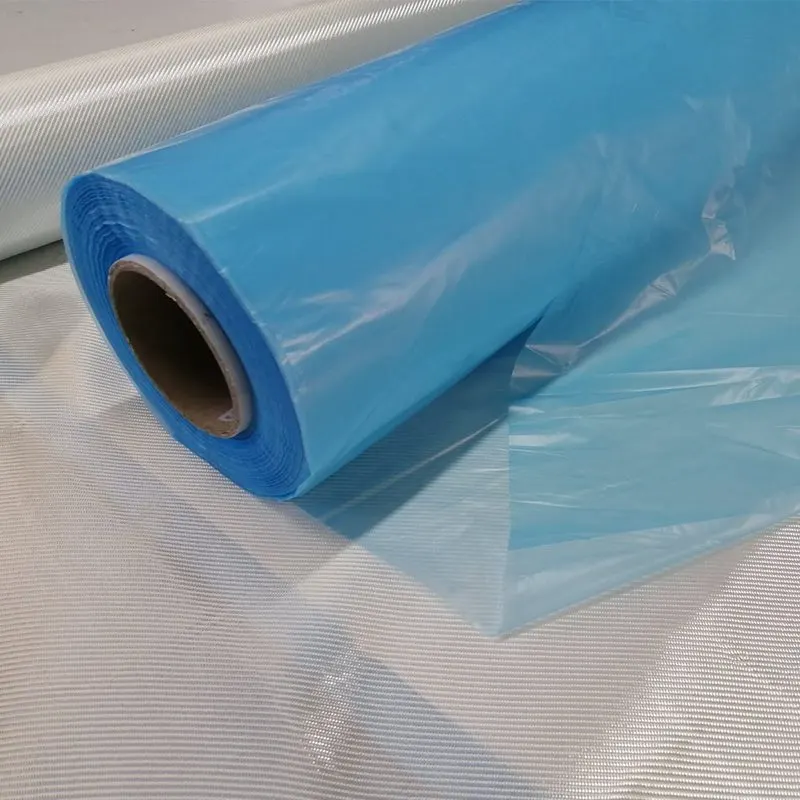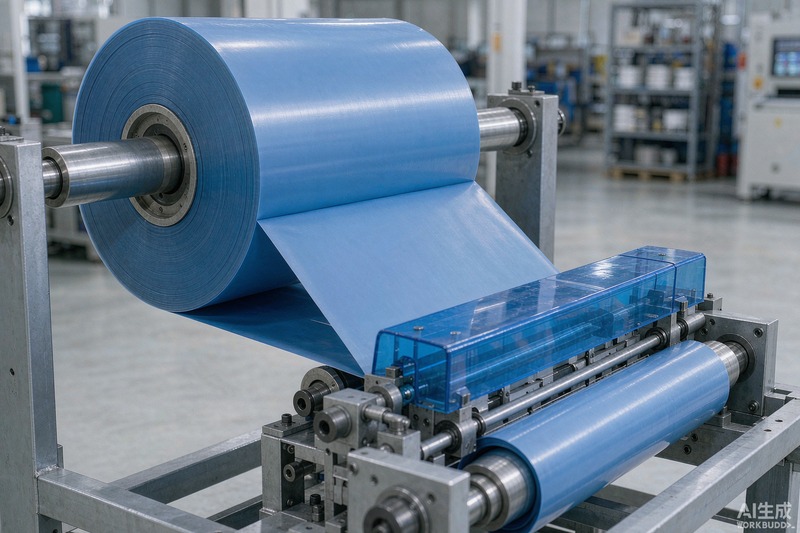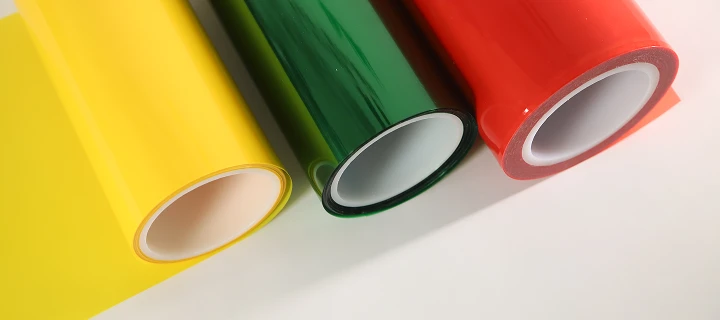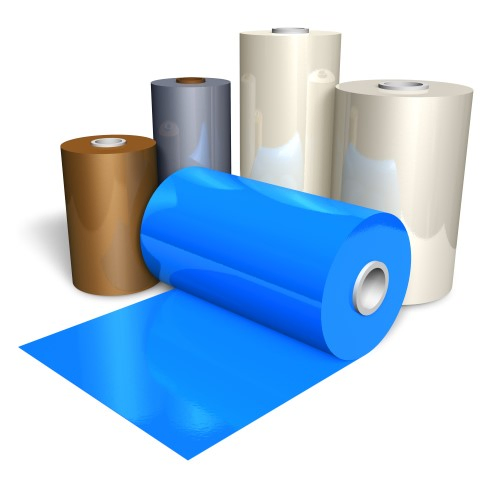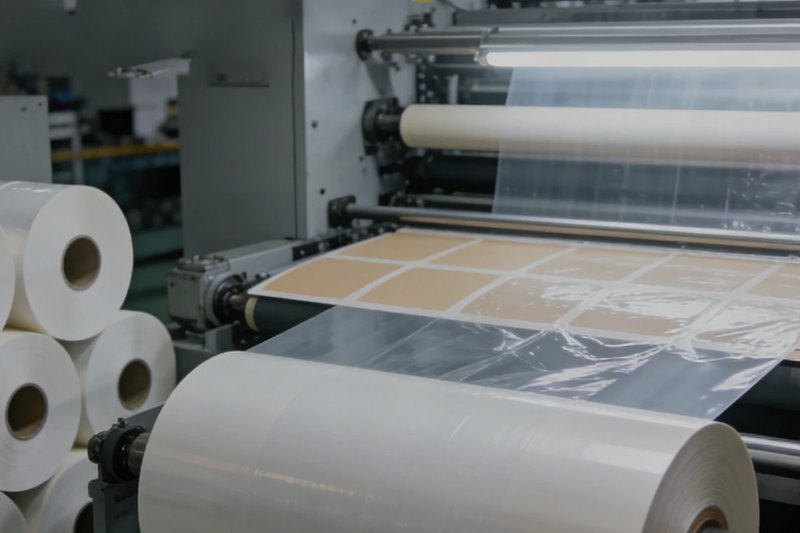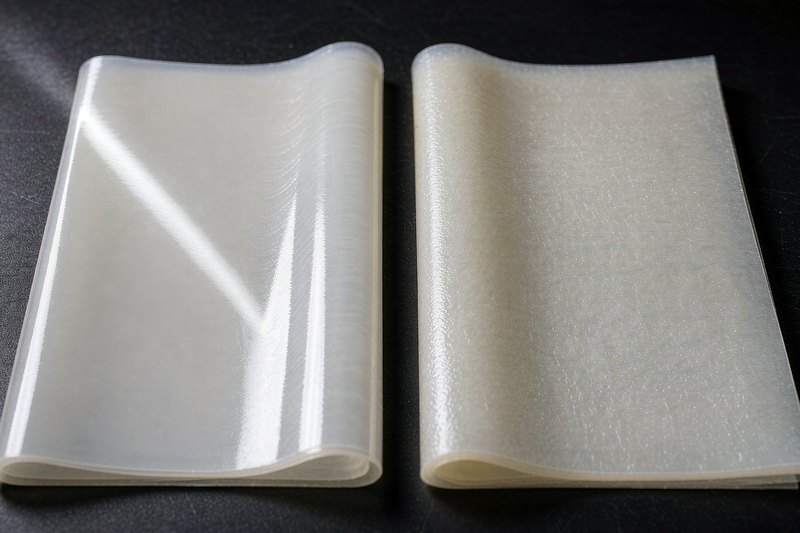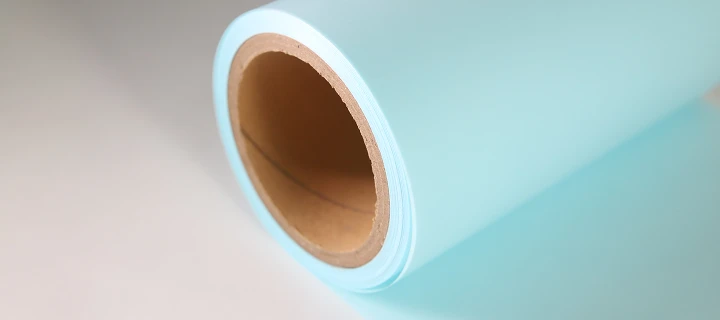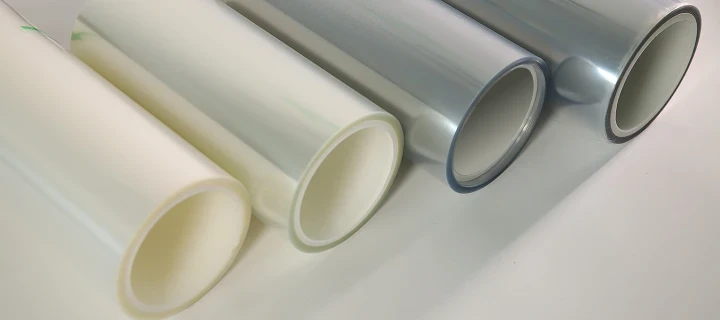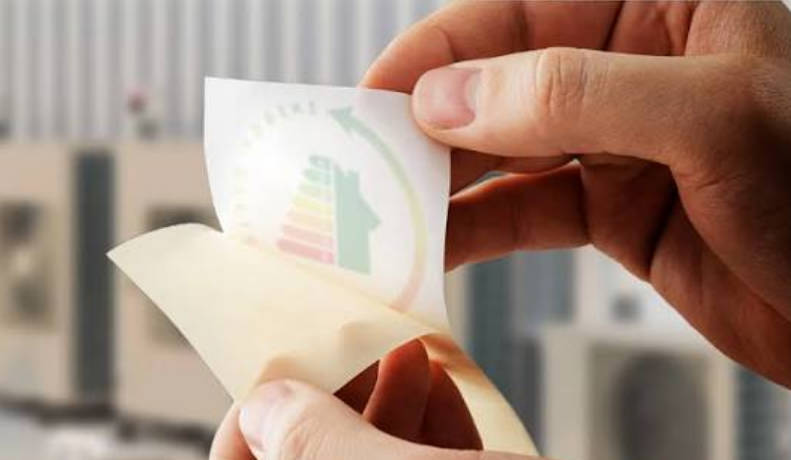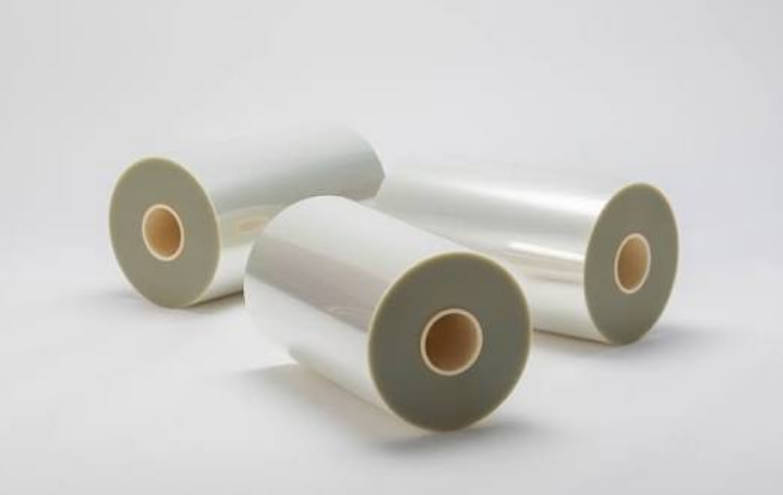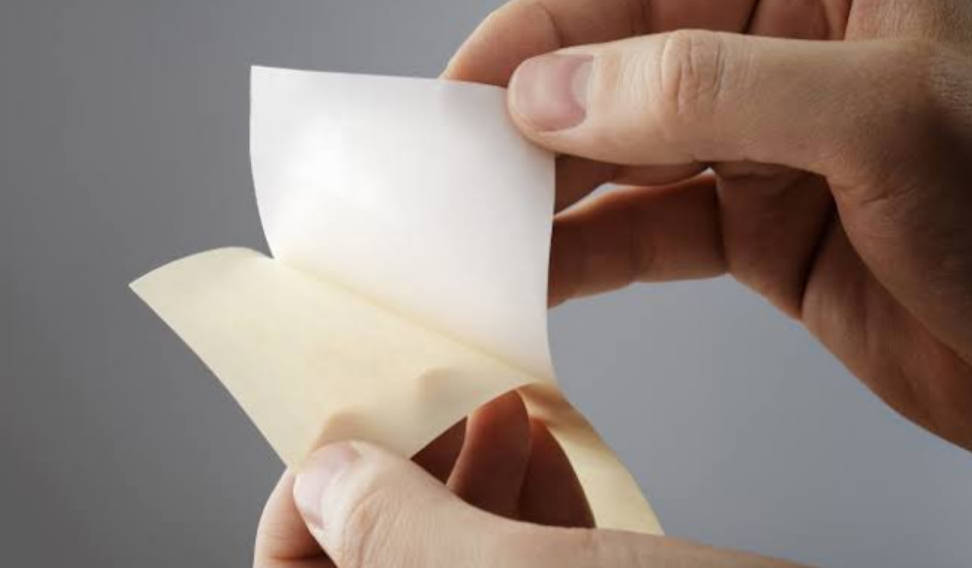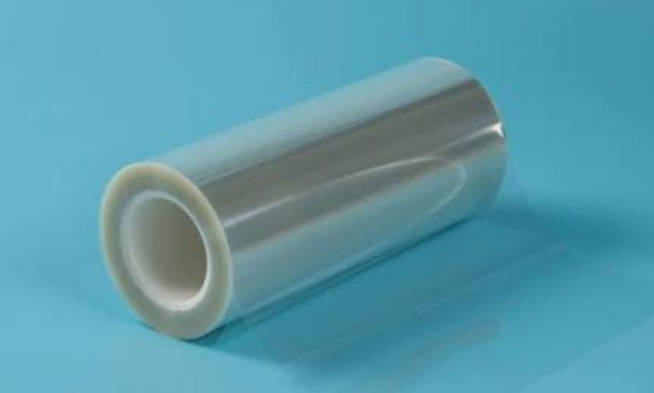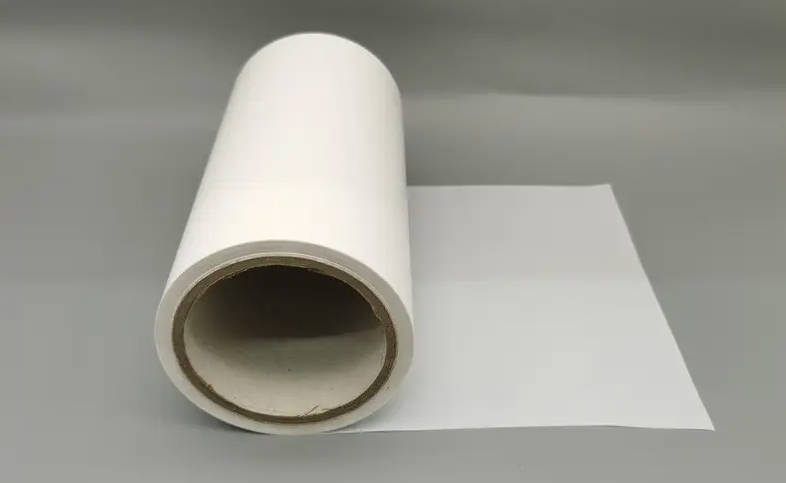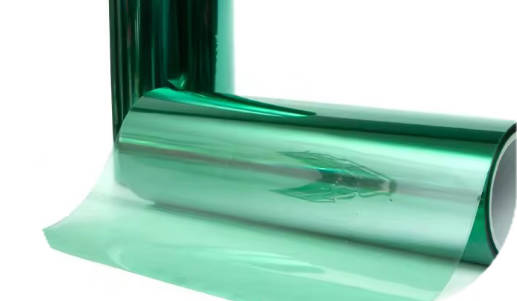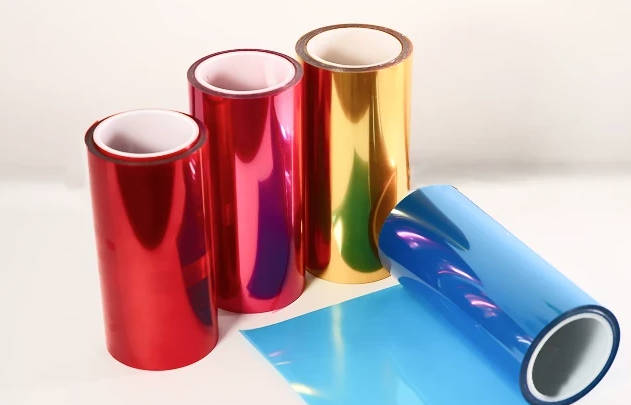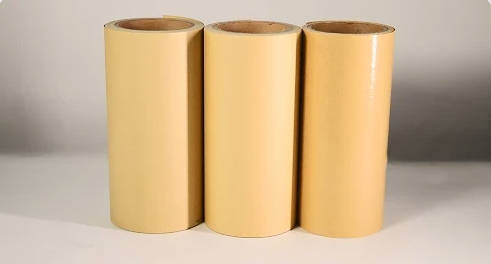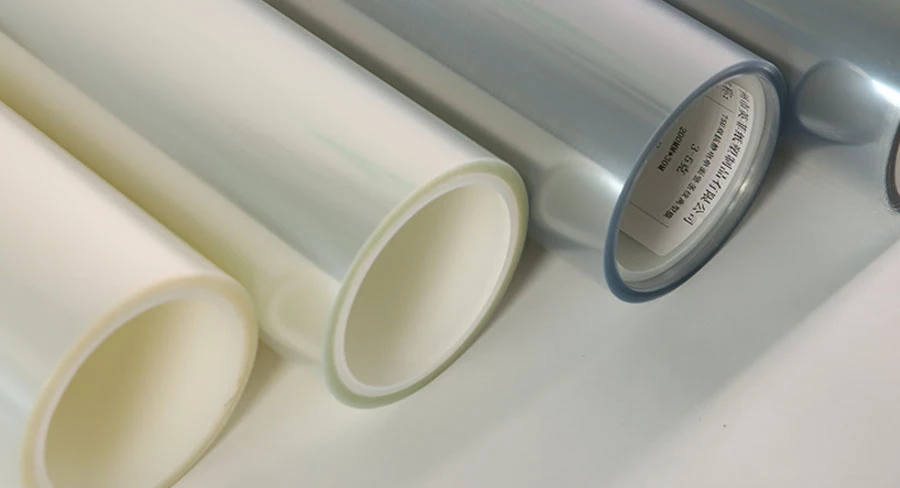
BOPP and PET release film are both silicone-coated carrier films, which is why they are often treated as one material in a sample book. On a running line they behave differently: the base film sets how the liner holds registration, how it survives heat, how it handles in the operator’s hands, and what it costs per square metre of usable liner.
The short answer is that PET release film is the safer choice for hot processes, thin and tight-tolerance liners, and applications where clarity or dimensional stability decides the outcome. BOPP release film is usually the more economical choice for room-temperature tape and label converting, where lower density and higher initial stiffness work in its favour rather than against it.
This guide compares the two substrates property by property, shows where each one reaches its limit, and gives a selection sequence you can run through before placing an order.
The Difference Starts With the Polymer
BOPP means biaxially oriented polypropylene. PET means polyethylene terephthalate, the polyester family also used for high-clarity films. Both are stretched in two directions during film production, which aligns the polymer chains and builds strength, but the two polymers do not respond to heat in the same way.
As temperature rises, PET keeps more of its stiffness and holds its dimensions; BOPP softens earlier and stretches more readily. PET is also the denser of the two, so a roll of the same thickness and width weighs more, while BOPP delivers more area for the same mass. None of this makes one substrate better in general terms. It means the two films cover different process windows, and the decision belongs to the application rather than to the material.
Substrate Properties Side by Side
The comparison below is qualitative on purpose: film grades, thicknesses and silicone coating configurations vary between suppliers, so exact figures should be confirmed against the datasheet of the product you intend to run.
| Property | BOPP release film | PET release film | What it changes on the line |
|---|---|---|---|
| Base polymer | Biaxially oriented polypropylene | Biaxially oriented polyester | Sets the thermal and mechanical ceiling of the liner |
| Behaviour under heat | Softens at lower temperatures | Retains stiffness at elevated process temperatures | Decides whether the liner survives drying, hot-roll lamination or hot-melt coating |
| Stiffness and handling | Stiff at room temperature, loses stiffness quickly as it warms | High stiffness retained across a wider process window | Affects web tracking, wrinkling and splice reliability |
| Dimensional stability | More sensitive to heat and humidity changes | More stable under heat and humidity | Drives registration and die-cutting accuracy |
| Optical clarity | Lower transparency with visible haze | High clarity and gloss | Matters for optical, display and clear film-label work |
| Density and cost position | Lower density, generally lower cost per square metre | Higher density and higher material cost | Drives cost per 1,000 labels or per roll of tape |
| Silicone anchorage | Needs consistent pretreatment and coating control | Well-established base for silicone coating | Both require corona or plasma pretreatment; process control decides release consistency |
| Typical fit | Room-temperature tape, labels, general protection | High-temperature tape, precision die-cutting, electronics, composites | Narrows the shortlist to one substrate in most projects |
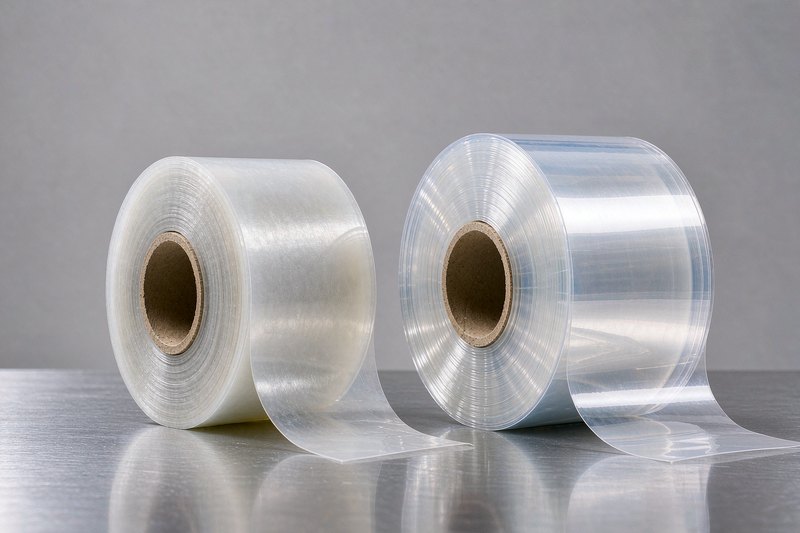
When PET Release Film Is the Better Choice
PET earns its higher material cost in four situations.
- Heat in the process. Hot-melt adhesive coating, heated lamination rolls, drying tunnels and any step where the web temperature climbs beyond the range where polypropylene stays stable. A liner that softens will stretch, wrinkle and lose registration.
- Thin liners with tight tolerances. When the liner is down to a thin gauge and die-cutting registration is measured in fractions of a millimetre, dimensional stability becomes the limiting factor. PET changes less with temperature and humidity, so the die-cut position stays where it was set.
- Clarity and surface quality. Optical laminates, display components and clear film labels need a liner that does not add haze, and a smooth coating surface that transfers a clean finish to the adhesive.
- Demanding downstream steps. Where the liner has to pass through more than one operation — coating, then lamination, then custom slitting or die-cutting — PET keeps its geometry through the sequence.
For adhesive tape lines running hot-melt or solvent-based adhesives with an in-line drying step, PET is normally the first substrate to evaluate. The same applies to converters producing pressure sensitive labels on high-speed rotary presses, where liner distortion shows up directly as register error.
When BOPP Release Film Is the Better Choice
BOPP covers the large middle ground of converting that runs at ambient temperature.
- Cost-driven volume work. General-purpose tape, protective film and standard label production, where the liner is a cost line rather than a technical bottleneck.
- Lighter rolls. Lower density means more area per kilogram at a comparable thickness, which reduces roll weight for manual handling and, in many cases, freight cost per square metre of delivered liner.
- Good moisture resistance. Polypropylene takes up essentially no water, so the liner is not the component that changes dimension when the ambient humidity swings.
- Useful stiffness for web handling. At room temperature the film behaves stiffly for its thickness, which helps keep long unsupported web spans flat on presses and rewinders that were not designed around thin film liners.
The limits are equally clear. Hot ovens, hot-roll lamination and heated nip sections are the wrong environment for BOPP, and projects that combine high humidity ageing with tight dimensional requirements should be qualified on trial rolls before a production order is placed. Where the appearance of the finished product depends on optical clarity, PET is the more predictable base.
What Actually Changes on the Converting Line
Die-cutting and kiss-cutting
The substrate decides how much the liner moves between the printing station and the cutting station. PET holds its dimensions, so die positions stay stable across a long run and thin liners can be cut at tighter tolerances. BOPP tolerates a wider tolerance band, which is acceptable for many tape and label formats but becomes a constraint when the cut must land within a narrow window.
Slitting and rewinding
Slitting settings cannot simply be copied between the two substrates. The films differ in modulus and in how quickly they relax, so tension, rewind hardness and blade setup need to be tuned per substrate to avoid burrs, edge dust and telescoping. This is one reason a supplier that can deliver a liner already slit to width — rather than a jumbo roll the converter has to process again — removes a variable from the process.
Adhesive coating and lamination
Both substrates accept silicone coating systems, but the web gets warm on the coating line. Under those conditions a BOPP carrier is more likely to stretch, so coating tension and oven temperatures have to be checked carefully; PET has more headroom. Release force itself is set by the silicone formulation and coating weight rather than by the base film, although substrate smoothness influences how consistently that force is delivered.
Incoming and in-process checks
Whatever the substrate, the liner should be qualified against the same four checks: release force on the actual adhesive, subsequent adhesion after storage, dimensional change under heat and humidity, and visual defects. A quality control routine that measures these on the delivered rolls rather than on a single sample is what keeps a substrate change from becoming a line stoppage.
Selection Sequence Before You Order
- Write down the maximum temperature the liner sees, including drying and lamination steps, not just the ambient shop temperature.
- Define the liner thickness and its tolerance, and decide whether the liner will be processed again after delivery.
- Set the target release force and state how it is measured, so the value means the same thing to you and to the supplier.
- Confirm the converting method: rotary die-cutting, flatbed die-cutting or laser, and the registration tolerance the job requires.
- Check appearance requirements — clarity, haze and the finish transferred to the adhesive.
- Compare cost per usable square metre rather than per roll, including expected waste and downtime.
- Run a trial roll under production conditions, including any ageing or humidity step the finished product will see.
FAQ
Is BOPP release film suitable for high-temperature processes?
Generally, no. BOPP softens at lower temperatures than PET, so it is a poor match for hot ovens, hot-roll lamination and hot-melt coating lines. For those steps, PET is the substrate to evaluate first.
Which substrate gives better die-cutting accuracy?
PET. It holds its dimensions better under heat and humidity, so die positions stay stable across long runs and thin liners can be cut to tighter tolerances than with BOPP.
Do BOPP and PET release films deliver the same release force?
Release force is set mainly by the silicone formulation and coating weight, not by the base film. Substrate smoothness and anchorage influence consistency, so the release value should be specified and confirmed for the exact film and coating combination you intend to buy.
Can both substrates be used with the same adhesives?
Both are compatible with common pressure sensitive adhesive systems, including acrylic, rubber and hot-melt types. What has to be matched is the release system to the adhesive chemistry, which is a coating decision rather than a substrate decision.
How do I choose for a label or tape line?
Start with the process temperature and the registration tolerance. If the line runs hot or the cut must land inside a narrow window, PET is the natural starting point. If the job runs at room temperature with a forgiving tolerance band and the liner is a cost driver, BOPP is usually the better commercial fit.
Conclusion
The choice between BOPP and PET release film comes down to four factors that appear in every project: process temperature, dimensional tolerance, appearance requirements and cost per usable square metre. PET holds stiffness and dimensions as the web warms, which is why it suits hot processes, thin liners, precision die-cutting and applications that need clarity. BOPP covers room-temperature tape and label converting at a lower material cost, with lower density that reduces roll weight and enough stiffness for comfortable web handling — provided it stays inside its thermal window.
On the line, the substrate changes die-cutting registration, slitting setup, coating tension and the checks you should run on delivered rolls. It does not change release force, which remains a function of the silicone coating, so film and coating have to be specified together rather than in sequence.
Send us the process temperature, liner thickness, release force target and converting method for your application, and we will recommend the substrate and coating combination that fits your line.